§48E Qualified Facilities
An O|Zone™ DX-Digital Container Port may comprise a location accommodating ISO Intermodal Containers in a traditional port configuration, such as a "free-trade zone", a site designed for a collection of specialized ISO Intermodal Containers referred to as a "Pod", a designated "Port", such as a ScanPort™ bringing together a grouping of Pods designed for specific purposes, and a "Campus" which may include one or more Ports and Pods.
A Port Authority Opportunity Zone™ (PAOZ) is a multi-county and/or multi-parish infrastructure framework designed to enable the coordinated designation, deployment, and operation of a Digital Container Port across its member jurisdictions, consistent with internationally recognized port, container, and transport frameworks reflected in United Nations charters and conventions governing ports and instruments of international traffic.
A Port Authority Opportunity Zone™ (PAOZ™) is the regional operating expression of the O|Zone™ Initiative.
PAOZs are intentionally structured to align with an existing, but often overlooked, layer of U.S. economic development infrastructure:
Regional Development Organizations (RDOs).
Since 1967, more than 500 RDOs have been established across the United States, typically operating at the multi-county level. These organizations were created to coordinate regional planning, federal and state grant programs, and economic development services on behalf of their member counties. Collectively, they are represented nationally through the National Association of Development Organizations (NADO).
Most people never hear about RDOs—yet they quietly shape transportation funding, 911 programs, workforce programs, housing initiatives, and long-range planning in nearly every region of the country.
PAOZs are designed to mirror the same regional geography used by RDOs.
The same counties and parishes that participate together in an RDO are grouped together within a corresponding PAOZ.
This is not accidental.
Where RDOs focus on public-sector coordination, planning, and grant administration, PAOZs are designed to focus on private-sector capital formation, infrastructure execution, and long-horizon operational integration.
The two models are complementary by design.
In simple terms:
RDOs organize and deploy public funding
PAOZs organize and deploy private capital and innovation
RDOs excel at navigating federal and state programs, compliance requirements, and public planning processes. PAOZs are designed to step in where those tools stop—bringing together private investors, operators, insurers, digital infrastructure, and physical assets into a unified regional framework.
PAOZs do not replace RDOs, compete with them, or seek to control them. Instead, PAOZs are structured to integrate with RDOs, providing a private-sector counterpart capable of executing projects that public grant programs alone cannot efficiently deliver.
This alignment allows regions to move beyond fragmented development efforts—where public planning, private investment, infrastructure, and operations occur in isolation—and toward a more cohesive regional system.
Regional Collaboration through the PAOZ Framework Within a Port Authority Opportunity Zone (PAOZ), the participating counties align their respective government authorities through a shared regional framework that enables coordination, interoperability, and collaboration across jurisdictional boundaries.
By joining the PAOZ, county authorities retain their local mandates while participating in regional planning, infrastructure alignment, and private–public integration at scale. This structure allows activities such as energy systems, digital infrastructure, logistics, emergency services, and environmental initiatives to be coordinated regionally, while preserving county-level control and accountability.
A PAOZ can support multiple initiatives simultaneously: healthcare infrastructure, digital systems, energy platforms, logistics, workforce facilities, and community services. Each initiative may begin locally, but the PAOZ provides the regional scaffolding that enables successful projects to scale across counties without being reinvented each time.
In this way, PAOZs act as regional platforms, not single-purpose entities. They create continuity across county lines, election cycles, and funding sources—while remaining grounded in the same geographic boundaries communities already recognize through their RDOs.
Within a Port Authority Opportunity Zone, O|Zone™ introduces the concept of the Digital Container Port (DX™) — a regional framework in which the entire PAOZ is treated as a unified, digitally coordinated container port rather than a single fixed facility.
At the core of this model is the use of specialized ISO intermodal containers — energy, health, ai compute, storage, communications, and hybrid configurations — designed to operate as intelligent, self-contained infrastructure equipment units. A container may operate independently, fully functional on its own, or be combined with other containers to form a purpose-integrated “pod” optimized for a specific use case such as scanning, energy production, compute density, or logistics.
What distinguishes a DX - Digital Container Port is its flexibility of deployment and use:
• Containers may be configured for immediate ingress and egress to support delivery and pickup, staged for medium- or long-term storage, or deployed in fixed-term stationary applications.
• The DX framework supports ground-level placement, stacking, and underground installation, depending on site design and operational requirements.
• Containers may be attached to, and detached from, a pad or foundation system in a manner that preserves mobility and avoids permanent affixation.
This allows infrastructure to evolve over time, be redeployed as needs change, and maintain its classification as transportable equipment rather than static real estate.
Geographically, a Digital Container Port is not confined to a single parcel. Multiple distinct sites can be designated across the counties within a PAOZ, each purpose-designed for its container or pod configuration, while remaining fully integrated into the same regional port framework.
Within a Digital Container Port, projects may be organized at multiple scales -
A Pod represents a modular grouping of GreenBox™ | JouleBox™ | GreenPad™ containers configured around a specific objective. Each Pod™ may integrate specialty equipment, thermal capture, storage and generation, electrical production, advanced AI computing, entropy-aware processing, communications, and related supporting functions within a unified operational framework.
A single Pod can be deployed at virtually any location within the Digital Container Port, and multiple parties may operate distinct activities within the same Pod™ under coordinated stewardship.
A Port, by contrast, represents a campus-scale deployment that brings together multiple Pods™ supporting different mandates.
A Campus may incorporate specialized Ports serving other functional purposes, all operating cohesively within the broader Digital Container Port environment.
A Pod installation in one county, an energy or compute cluster in another, and supporting infrastructure elsewhere are not necessarily separate projects — they may be coordinated nodes within a single PAOZ-wide Digital Container Port.
Digitally, all containers operating within the DX environment are designed to communicate with one another, share operational and telemetry data, and coordinate activity globally.
While “in port,” containers may also undertake their traditional marine admiralty and port-related functions, translated into a digital and terrestrial context. This creates a system in which physical infrastructure, digital coordination, and regulatory logic operate together as a unified whole.
Through this modular, container-based architecture, O|Zone enables infrastructure that is scalable, mobile, and adaptive — capable of expanding across regions, integrating diverse functions, and responding to changing economic and community needs without redesigning the underlying framework.
O|Zone™ and PAOZ provides a local organizational approach to coordinate innovation in private–public–community partnerships, enabling regions to move faster while remaining locally grounded.
ScanPort™ represents the first initiative to utilize the O|Zone™ framework and Port Authority Opportunity Zone™ regional architecture, integrated within a Digital Container Port, using a range of ISO Intermodal Container models.
Community Leaders & Regional Authorities
Healthcare Access as Economic Infrastructure
Every community needs dependable access to advanced healthcare — but most counties can’t afford to build or equip advanced diagnostic centers.
The ScanPort framework is designed to change that. It treats diagnostic infrastructure as civic infrastructure — just like roads, broadband, or clean water. Each ScanPod site is a modular diagnostic pod built, delivered, and operated within a county under the O|Zone Port Authority Opportunity Zone (PAOZ) framework.
These pods are designed to provide advanced digital imaging capabilities — MRI, 3D-CT, PET-CT, robotic X-ray, and digital mammogram — within reach of residents, schools, and local healthcare providers.
How It Works
Your county, through its Port Authority or designated development agency, hosts a ScanPort site within an eligible Opportunity Zone.
The facility and equipment are fully funded and installed through the O|Zone structure, so the county incurs no direct debt or capital obligation.
Local hospitals and clinics manage scan operations, and a share of site revenue returns to the county authority under the PAOZ charter — creating a steady income stream to support community health initiatives, workforce programs, or infrastructure improvements.
The Local Economic Benefit
Every ScanPort site brings high-skill technical and clinical jobs, recurring service and maintenance contracts, and procurement opportunities for local vendors.
Beyond healthcare, the pods act as regional innovation anchors, attracting research partners, data analytics projects, and AI development opportunities.
Creates durable new jobs in advanced healthcare technology.
Generates recurring county revenue from diagnostic operations.
Reduces travel time and medical costs for residents.
Positions the county as a leader in digital infrastructure and health equity.
A Turnkey Model for Counties
ScanPod sites are delivered as ready-to-operate facilities. All permitting, construction, and compliance work is handled by a Project Steward in cooperation with your local authority.
Each installation becomes part of the statewide ScanPort network, ensuring interoperability and coordinated scheduling between counties.
Your role is simple: designate the site, support community engagement, and benefit from the shared revenue that flows back through the O|Zone trust structure.
Partnership in Practice
Every county deserves world-class healthcare access — and every local government deserves a model that strengthens both health and economy.
ScanPort transforms diagnostic care from a private luxury into a public-benefit utility, built on private–public partnership, designed for speed, and sustained through shared success.
Becoming an O|Zone Developer Partner
Every Pod and Port site begins with land. That’s where the developer group comes in. Whether it’s an individual with local development experience, a regional partnership, or a construction consortium, these are the people who identify, prepare, and deliver the ground-ready locations where each Pod will locate.
1. The Role of the Developer
The developer’s job is to take a raw piece of land—often within a Qualified Opportunity Zone—and transform it into a fully prepared site capable of supporting a Pod™, an entire Port or a Campus.
That means:
Acquiring or controlling the land, often with the landowner as a joint participant.
Managing site preparation: grading, roads, parking, drainage, water, sewer, electrical, and broadband conduits.
Constructing the certified GreenPad foundations that the modular GreenPads will mount to enabling the Companion Container Sets to be locked into the GreenPads in a manner similar to ISO Intermodal Containers locking into other ISO Containers on a ship.
Each GreenPad can be built directly on grade or above a bunker or basement structure, depending on site conditions or design requirements. These sub-structures can house mechanical systems, shielded power nodes, or entropy recovery hardware—all connected upward into the GreenBox containers that form each Pod.
2. Private-Sector Development, Public-Sector Ownership
All of this early work—the site acquisition, design, and construction—is done privately by the developer. That’s deliberate. It avoids the time, cost, and constraints of public-sector bidding during the build-out phase and keeps local control in the hands of experienced professionals.
Once the site is complete, the developer sells the finished property to the O|Zone Governmental Authority—a special-purpose authority established by the county as part of the broader O|Zone Initiative.
The purchase may be funded through tax-exempt municipal revenue bonds issued by that authority. These bonds are non-recourse to the county and are secured solely by the revenue streams associated with the Pad, Port or Campus infrastructure.
3. The Lease-Back Framework
Immediately following the sale, the development group leases the site back from the authority. The lease term is 20 years, fully prepaid at closing, with multiple renewal options extending up to 99 years.
This structure provides: The developer with a tax-advantaged synthetic bond-like position, effectively capturing the long-term value of a municipal lease without having to issue its own debt.
The authority is provided with an upfront capital inflow from the prepaid lease, strengthening its position to fund additional infrastructure or establish reserve funds.
This creates a public–private alignment where the developer holds long-term operational control and revenue participation, while the governmental authority retains title and statutory bond status.
4. Why It Matters
For counties, this model delivers ready-to-use infrastructure without taxpayer funding. For developers, it offers a repeatable, scalable business: acquire land → prepare sites → sell to authority → lease back → participate in the ongoing revenue from Campus operations.
Because each Pod, Port or Campus site is built within the O|Zone framework, the developer may benefit from Qualified Opportunity Zone treatment, local economic incentives, and participation in O|Zone™ Opportunities applicable to the Pod, Port or Campus.
5. The Financial Foundation
This lease-sale-leaseback framework is more than a transaction—it’s the foundation of the O|Zone™ ecosystem. It ensures that every site is privately executed, publicly owned, bond-financed, and sustainably operated.
It gives developers a way to build permanent, income-producing assets while delivering essential infrastructure that supports economic and services access expansion, research innovation, and community economic renewal—all within the O|Zone bond and trust structure, administered by a local Community Bank.
Economic Participation and Financial Involvement
Acquiring an Infrastructure that Heals and Endures
Every ScanPod or ScanPort site represents more than advanced scanning technology — it’s a revenue-producing asset that blends innovation, efficiency, and purpose. Each site is powered by private–public collaboration, combining world-class equipment with modular infrastructure that can be deployed rapidly, sustained locally, and operated efficiently.
For individuals, families, and institutions seeking meaningful economic participation, the opportunity is simple: you acquire scanning equipment and/or GreenBox containers — not stock, not membership interests, but real, tangible equipment assets that serve communities while producing revenue.
1. Scanning Equipment Ownership
Private participants may purchase individual or multiple scanning systems — MRI, 3D CT, PET-CT, robotic X-ray, digital ultrasound or digital mammogram. Each unit is owned outright by the purchaser and placed into operation within an operating ScanPod or ScanPort site.
Hospitals and clinical operators staff and operate the scanning equipment.
The program shares net scanning revenues with equipment providers.
Purchasers may claim 100% bonus depreciation under § 168(k) once "placed in service".
Many systems, when paired with container-based micro-grid infrastructure, may also qualify for partial ITC treatment for their integrated components.
In practice, this means purchasers offset taxable income in the first year, while retaining title to a high-value asset that produces ongoing revenue.
2. GreenBox Container Ownership
Each GreenBox is a premium, ISO-certified, thermodynamic compute environment — a next-generation intermodal container built to house energy systems, secure electronics, and scanning infrastructure.
GreenBoxes are not passive real estate. They are classified energy property under 26 U.S.C. § 48 and § 168(k): 100 % Bonus Depreciation: Eligible once "placed in service" in international waters.
Investment Tax Credit (ITC): Up to 40 % of qualifying basis when placed in service as an energy-generating, energy-storage, or micro-grid asset.
Energy Components Include:
Roof and wall integrated thermal recovery systems.
Phase-change thermal management and micro-turbine modules.
SMR micro-reactor or Stirling-based or SuperCritical CO2 co-generation options.
Energy-storage and waste-heat recovery assemblies.
Digital Twin / Control Intelligence Layer managing all power and thermal operations (qualifying under “micro-grid controllers,” § 48(a)(3)(A)(xi)).
Electrochromic ballistic glazing and environmental control systems.
When a GreenBox is delivered and enters service (typically when deployed in transit), its owner may claim both the depreciation and ITC.
3. Real-World Simplicity
This is an asset-based structure: A purchaser buys scanning equipment and/or GreenBox™ containers.
The assets are deployed, used, and administered by professional Technical Stewards.
Purchaser receives documented tax incentives.
4. Compliance and Advisory
All information is descriptive and for educational purposes only. Participants should consult their own tax counsel or advisors regarding applicable tax incentives.
The illustration above can be applied a broad range of applications and modular configurations.
(Some modules described in the context of digital imaging applications)
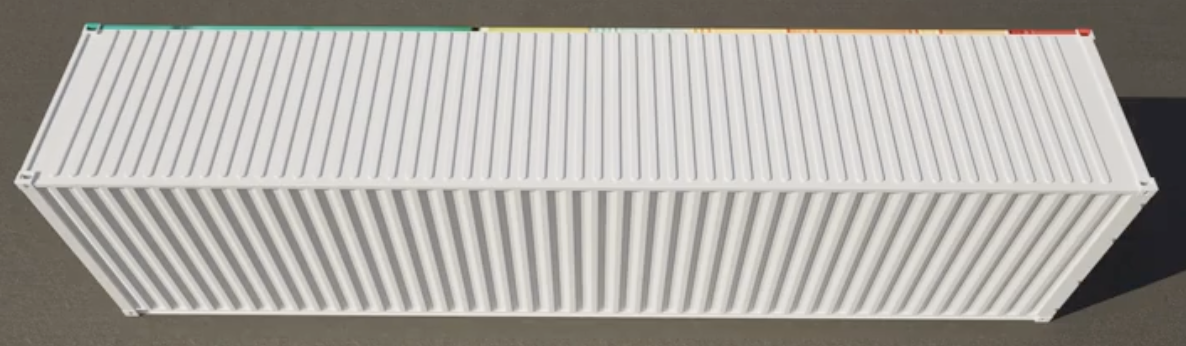
GreenBox™ — Beyond Mil-Spec-grade. Built for Discovery.
GreenBox is more than an ISO intermodal container — it’s a self-aware infrastructure system engineered Beyond Mil-Spec™ for extreme environments and high-value transport. Each unit integrates graphene heat exchangers, EMP shielding, and phase-change energy cells that generate and recycle power while in motion or at rest.
Guided by embedded Digital Intelligences, GreenBox systems transact autonomously, monitor cargo integrity, and sustain onboard labs or compute environments anywhere on Earth. Whether carrying health imaging systems, data centers, or mission-critical materials, every GreenBox functions as a secure, intelligent habitat — a vessel for power, precision, and discovery.
👉 Tap or click the container image above to access GreenBox website.
Powered by
GreenBox™ ISO Intermodal Modular Containers combine to form a ScanPod™.
Applying a modular approach to enable rapid manufacture and installation of specialty equipment, fit for purpose, designed to create a broad national infrastructure of advanced digital full body scanning, thermal energy sourced electricity production, and advanced AI compute nodes to evolve digital intelligent DigitalTwin™ nodes for each participant
A ScanPod™ can be located in a Qualified Opportunity Zone, next to a hospital, within a shopping centre parking lot, on a discrete site or within a ScanPort™ multi-modality campus.
ScanPort-OKCMetro™ is one of the first applied initiatives operating within the broader O|Zone™ framework, demonstrating how local projects can be developed once and deployed many times across a region.
GreenBox redefines what a container can be. It is designed to move not merely as cargo — but as an intelligent vessel aware of its environment, its load, and its mission.
Every surface, corner, and seam has purpose. Its unique 8’ and 10’ increment side castings extend structural integrity through interlocking rails, enabling offset, parallel, or perpendicular coupling. Magnetic locks and dual-axis rails create unmatched rigidity across shipboard stacks, stabilizing entire decks while expanding new geometries for high-value configurations.
In motion, GreenBox becomes a self-sustaining organism. Its external sensor suite—visual, thermal, weather, and long-range atmospheric—continuously maps transit conditions, while internal sensors monitor microclimate, vibration, and radiation across all payload zones.
During ocean or overland transport, GreenBox generates its own energy—absorbing BTUs through its graphene exchanger skin, harvesting solar radiation, and storing it in phase-change cassettes that operate as modular micro-reactors. The system is designed to maintain cryogenic and frozen-state cargos without external power, extending preservation windows far beyond conventional limits.
Upon arrival, GreenBox docks seamlessly with GreenPad™ docking pads, transferring its stored thermal and electrical energy into port systems—linking directly to geothermal wells, energy recovery loops, and digital metering networks.
Beyond logistics, GreenBox acts as a transnational transactional node—a mobile data center powered by embedded Digital Intelligences. Operating across jurisdictions and in international waters, it maintains secure quantum identity, encrypted quantum keys, and autonomous CalypsoCube™ datastores that record every transaction in motion: cargo verification, carbon offsets, energy exchange, and digital customs clearance. Each GreenBox is designed to maintain its own sovereign digital ledger, enabling compliance, payments, and regulatory transparency in real time. Its onboard Digital Intelligences are configured to orchestrate data routing, optimize energy flow, and negotiate inter-system protocols, transforming each voyage into a live, audited exchange between nations, networks, and machines.
Every journey is a closed-loop cycle of power, data, and motion—a container that thinks, heals, and contributes wherever it lands.
— 16’ × 40’ of Intelligent Purpose
When two GreenBox containers join, they form a unified 16-foot by 40-foot interior — a precision-sealed, energy-synchronized chamber engineered for temporary or extended specialty applications. Within this Companion Container Set, every wall, ceiling, and floor is alive with function: capturing, storing, shielding, and computing.
GreenBox – Beyond Mil Spec version integrates full-spectrum kinetic, frequency, and EMP protection, with multi-layer graphene and Faraday lattice shielding on both interior and exterior surfaces. Each surface not only defends — it works. The structure continuously absorbs and converts BTUs into electrical power, feeding underfloor phase-change SMRs that operate whether or not solar panels are deployed above.
In this configuration, energy systems operate in redundant dual arrays, sustaining full functionality even under isolation. Waste heat from embedded specialty processes — imaging systems, AI clusters, or experimental workloads — is captured, re-routed, and reconstituted into usable power.
The Companion Container Set becomes a self-sustaining data center, its intelligence amplified by embedded Digital Intelligences that manage power flows, environmental equilibrium, and data integrity in real time. It is a complete beyond-AI infrastructure node — one that thinks, defends, and generates, wherever it stands.
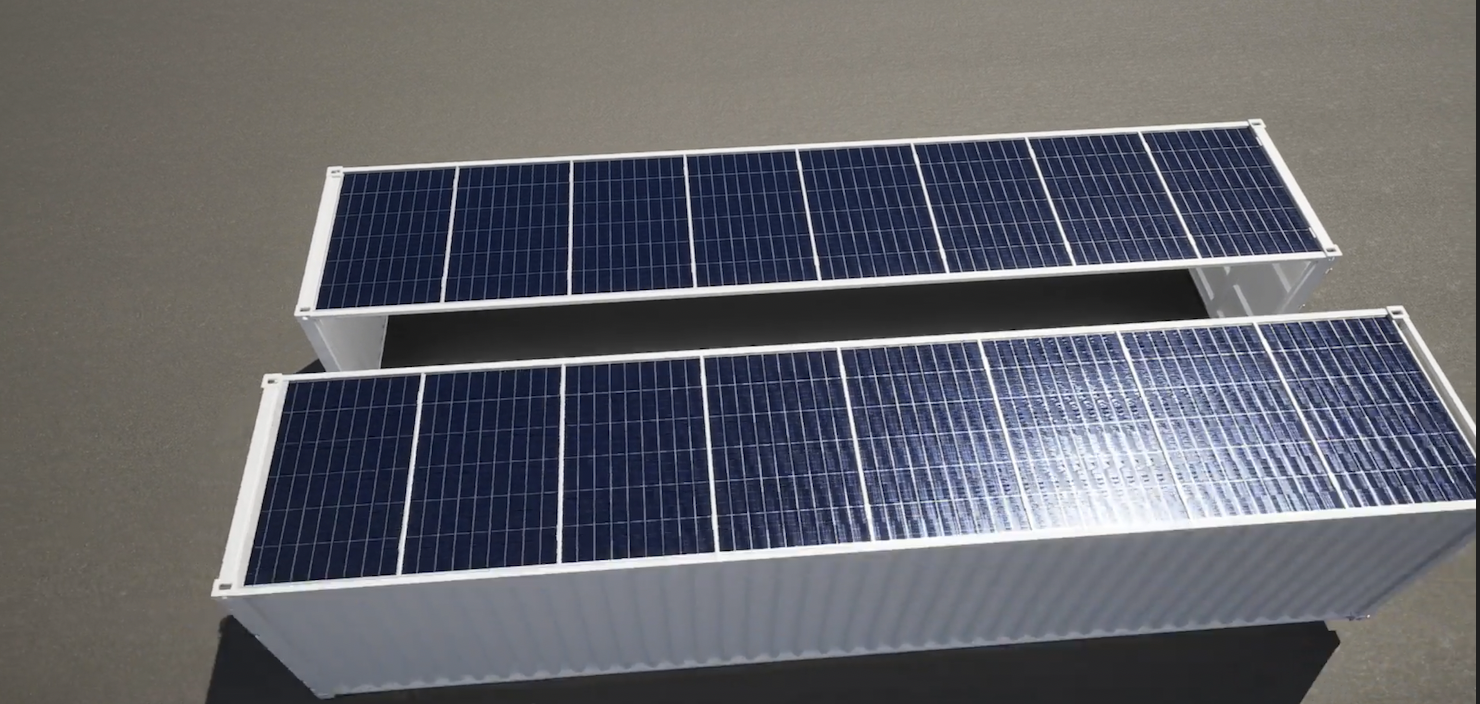
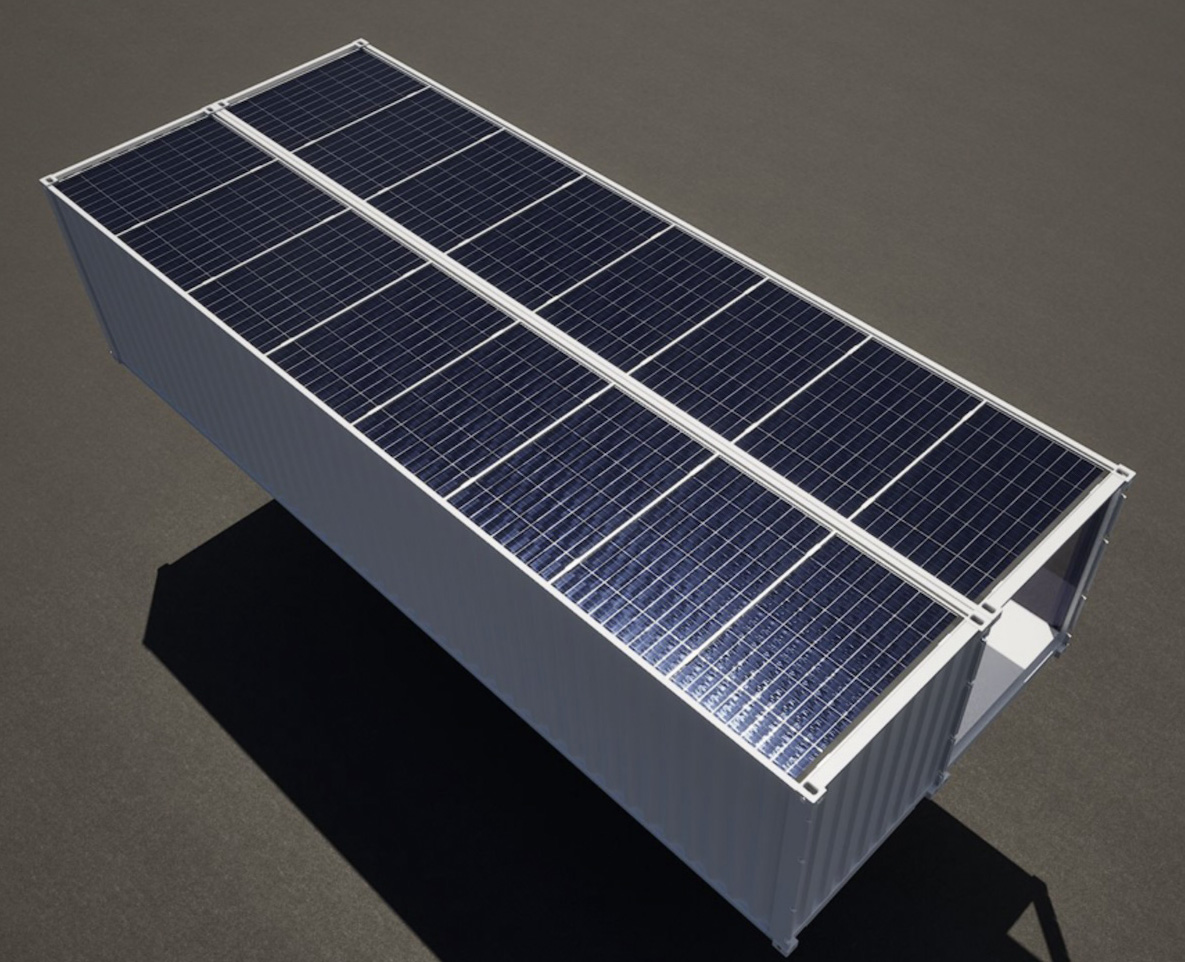
GreenBox exterior side walls are engineered as removable, modular structural panels, enabling containers to be interconnected, separated, and reconfigured over time.
In addition to the standard ISO intermodal configuration—comprised of four upper and four lower corner castings—GreenBox introduces supplemental side castings positioned along the container length at horizontal intervals of eight feet (8′) and ten feet (10′), at both the upper and lower structural planes. These additional castings enable lateral container coupling, structural load sharing, and multi-container assemblies that extend beyond conventional end-to-end configurations.
The removable side panels are designed to be detached, reinserted, and resecured as required to support transportation, redeployment, and on-site reconfiguration, without compromising ISO handling, stacking, or intermodal transport compatibility.
GreenBox further incorporates engineered thermal and airflow interfaces across the side walls, roof, floor, and end-door assemblies. These interfaces support the controlled capture, redirection, exchange, and/or dissipation of thermal energy, depending on operational requirements.
Collectively, this architecture enables flexible system scaling, advanced thermal management, structural modularity, and lifecycle adaptability across stationary, semi-mobile, and redeployable deployments within and between O|Zone™ Digital Container Ports.
JouleBox™ — Each JouleBox™ is engineered as an ISO intermodal container purpose-built for clean energy storage, with a primary focus on thermal energy storage and temperature manipulation. In this configuration, JouleBox™ is designed to qualify for §48E clean energy storage incentives.
The principal distinction between a standard GreenBox™ and a JouleBox™ lies in functional emphasis: JouleBox™ is optimized for clean energy storage, whereas GreenBox™ configurations are typically equipped for both electricity generation and energy storage. A JouleBox™ can also facilitate geothermal infrastructure and enable long-term storage.
JouleBox™ can also be engineered for subsurface and hardened deployments, including underground installations, interconnecting tunnels between ScanPods, EMP-shielded AI compute environments, and point-to-point utility infrastructure where resilient, non-generative energy storage is required.
Core Module -
From these core "Pod" modules come larger, multi-use structures.
Here one can see a four-unit (2×2) configuration with integrated stairwell and elevator—built to ADA standards, which may include bullet- and blast-resistant exteriors.
These same cores can become clinics, shops, offices, restaurants, or living suites, depending on finish and fit-out.
Every unit is designed to connect laterally and vertically, giving developers near-limitless flexibility to create safe, energy-efficient environments that evolve with community needs.
Adding a GreenPad under each ISO Intermodal Container enables a Pod to be connected into a campus-setting Thermal Utility Engine, to facilitate access to campus-wide utilities.
A mix of GreenBox™ and JouleBox™ core modules can enhance electrical generation across a Pod, and assure electricity capacity limitations are achieved for §48E Qualified Facility tax incentives.
A key objective of Pod configuration is to generate more electricity than such Pod consumes, although no assurance can be given.
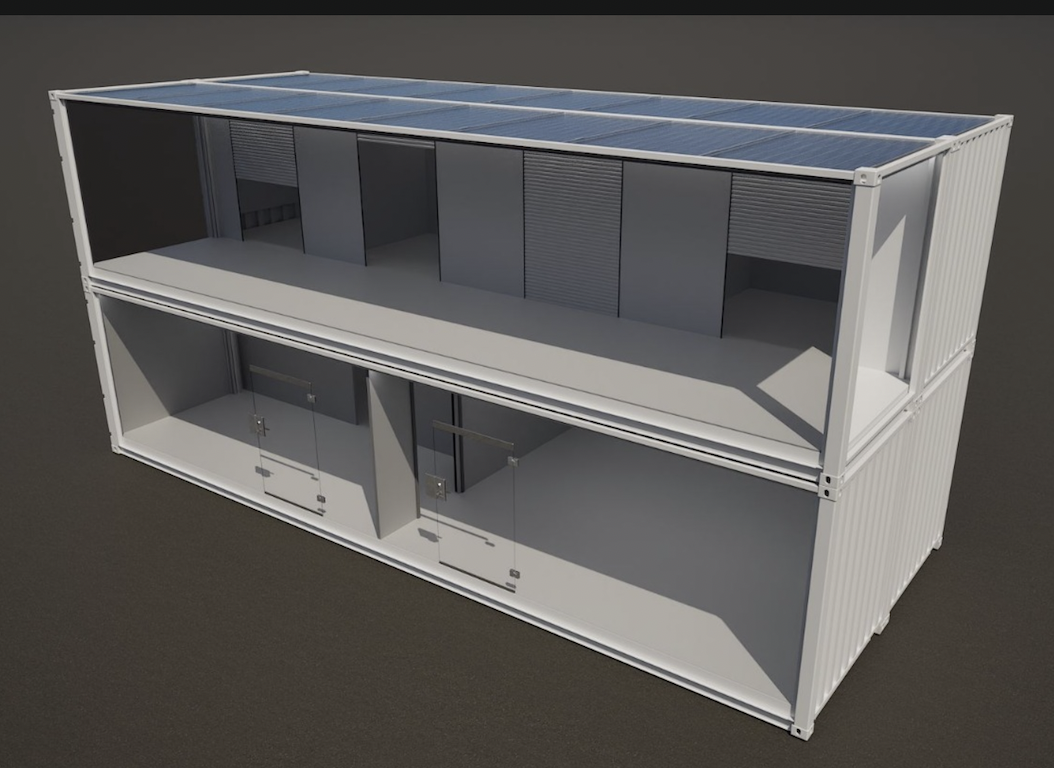
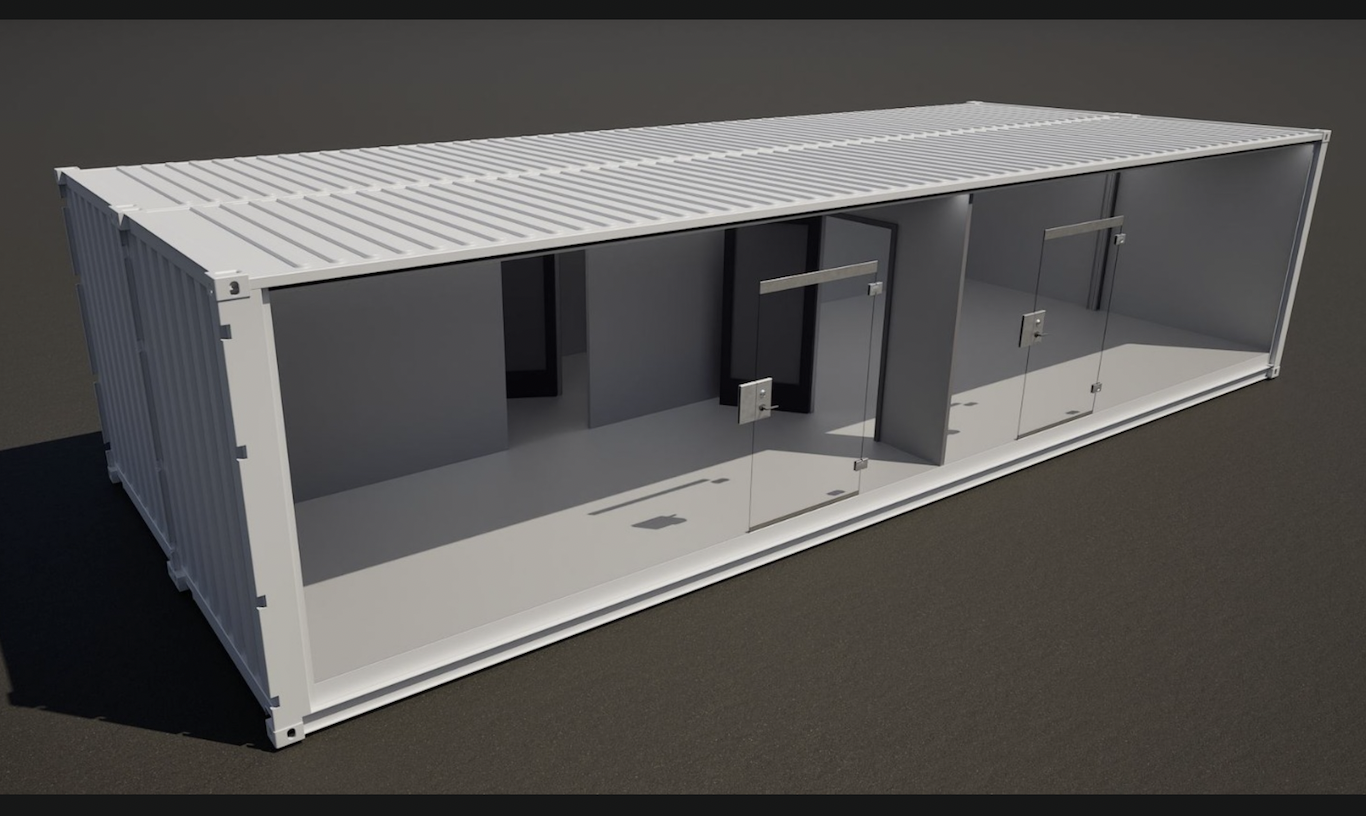
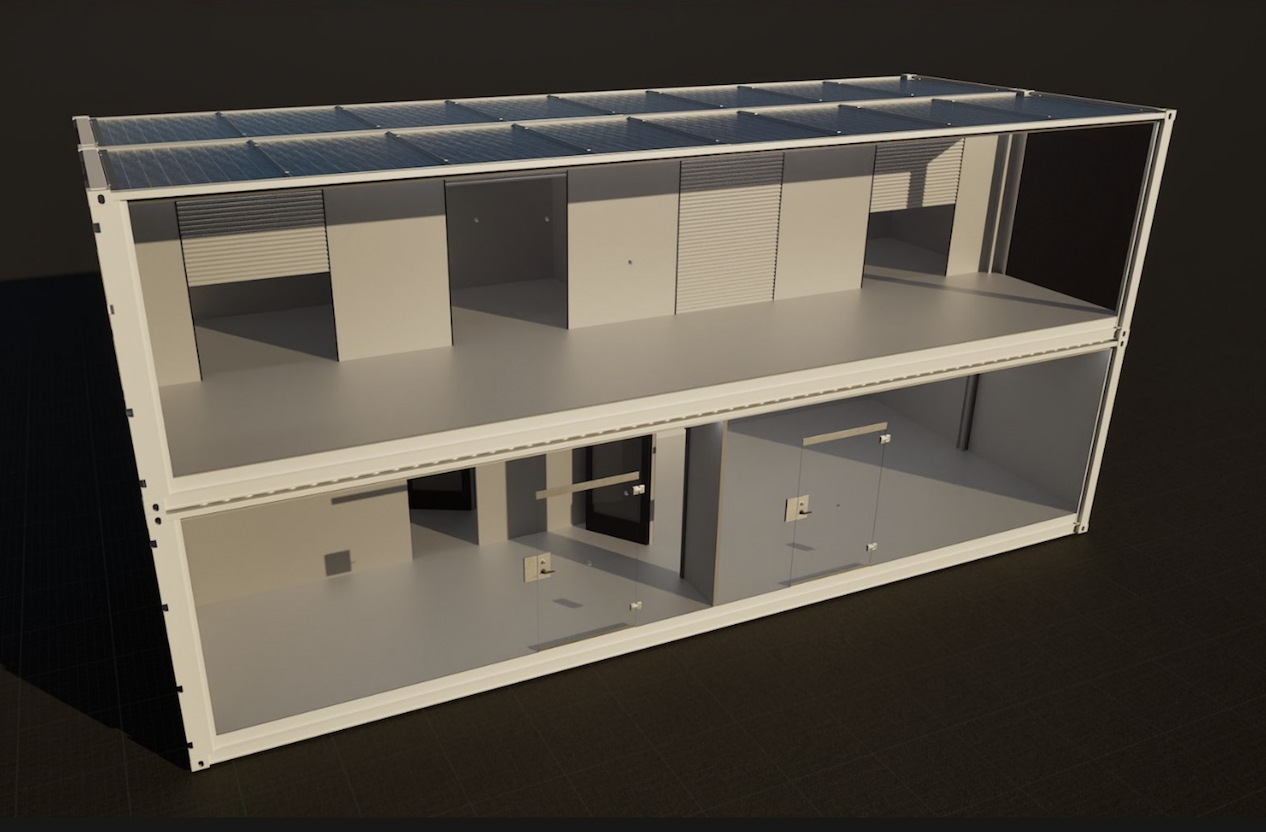
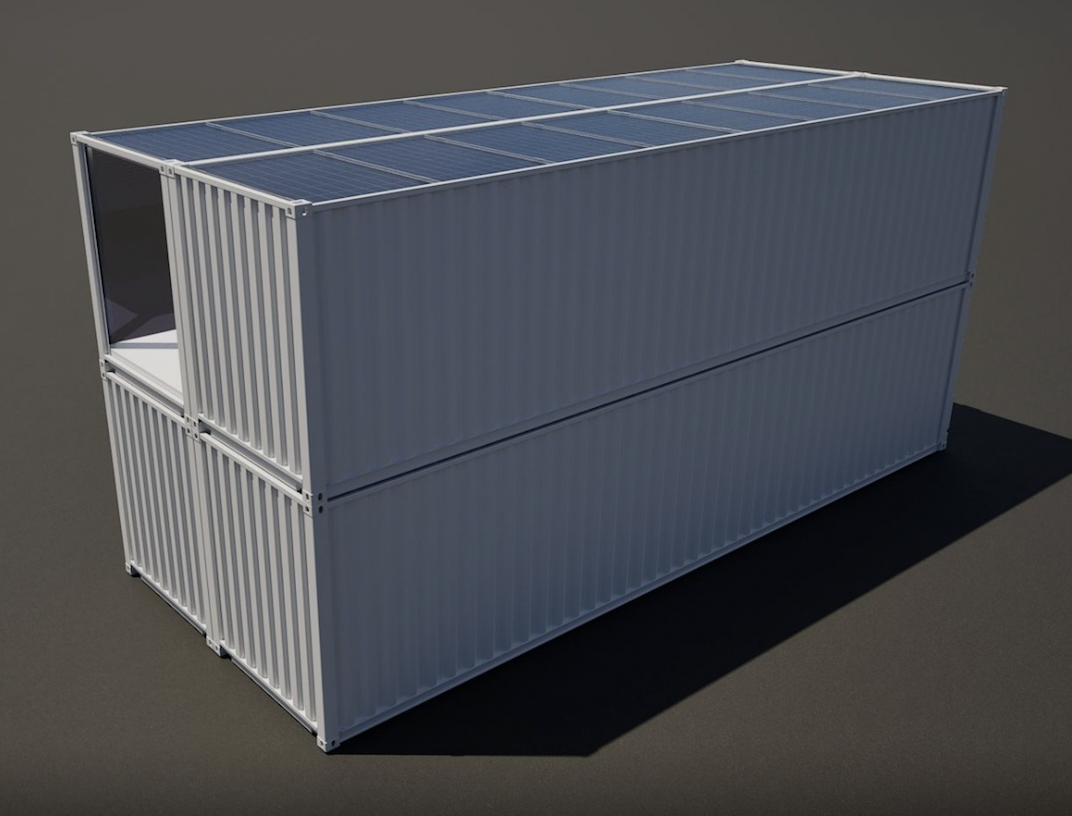
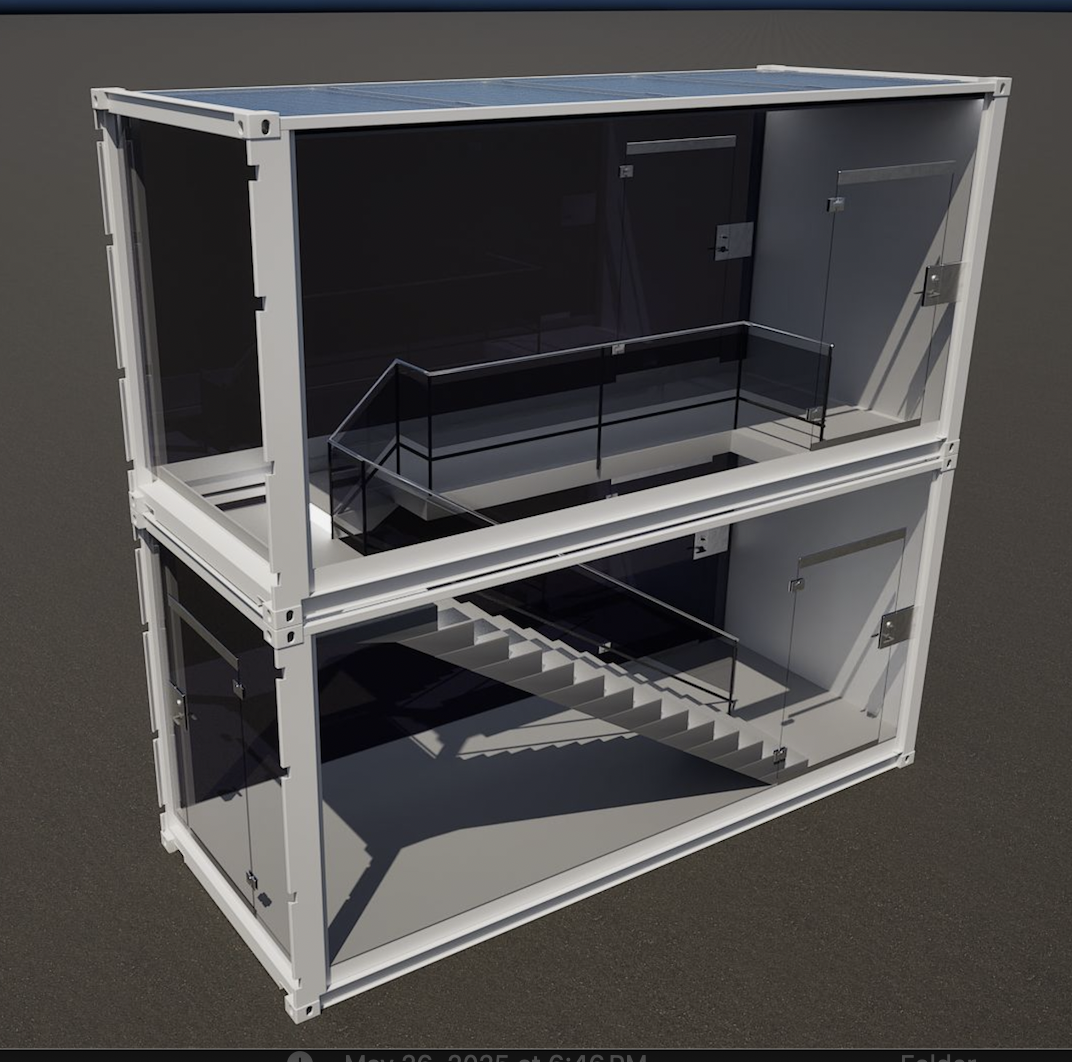
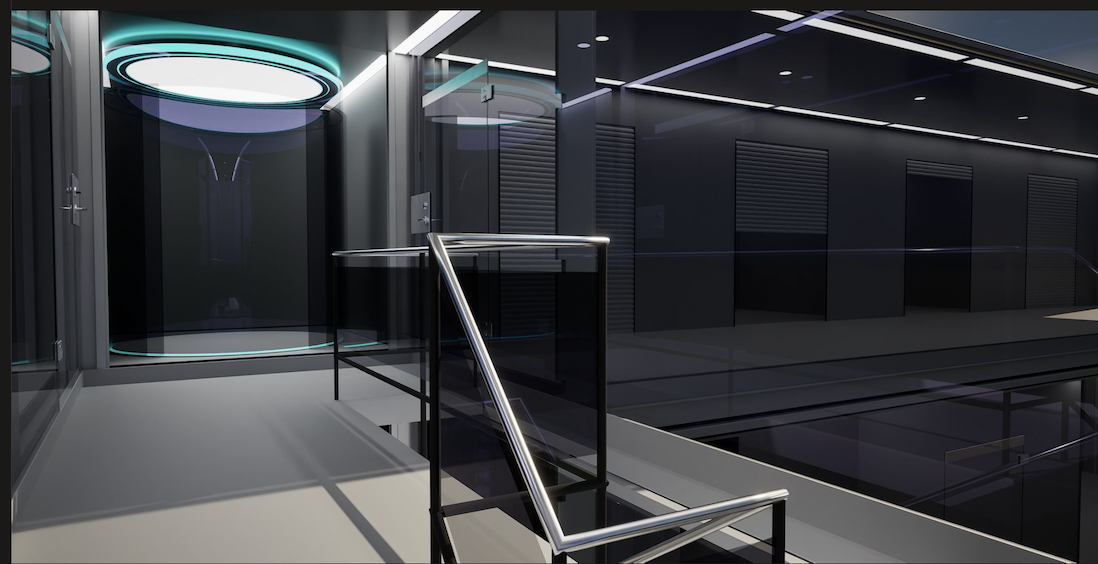
Illustrated above are a two-story stair assembly, an elevator container, and multiple Campus security hallway assemblies. When combined with GreenPad™ foundations, these modular components form a structural exoskeleton that supports piping, wiring, thermal management, and geothermal integration across single-Pod and multi-Pod configurations.
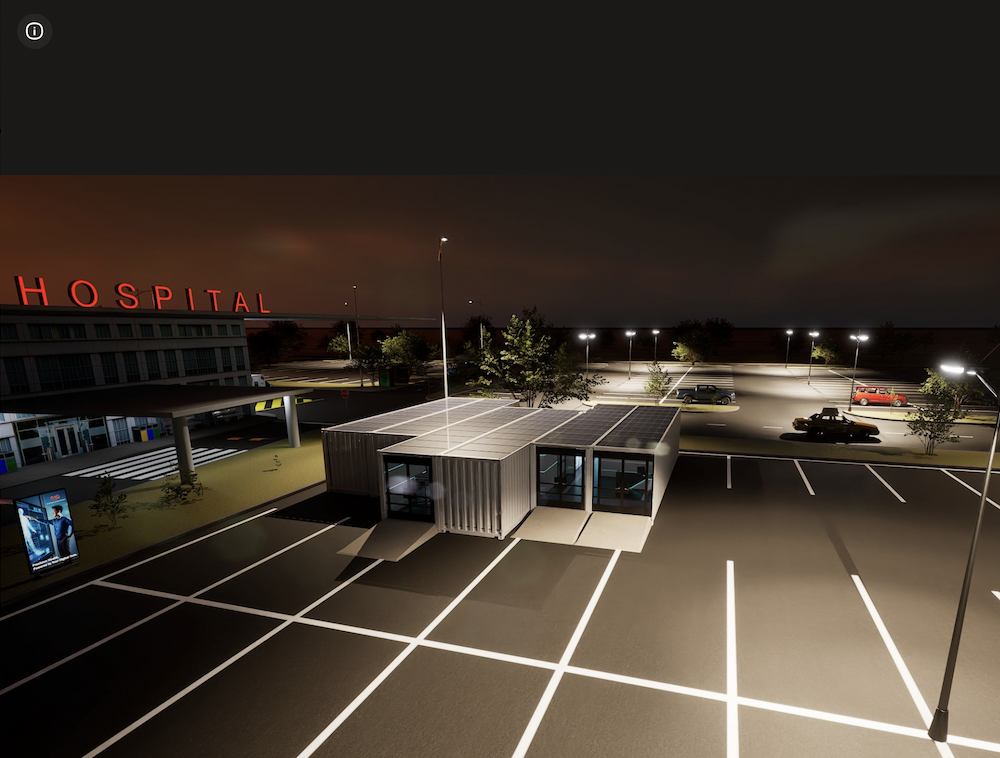
Each ScanPod™ houses an advanced digital scanning modality designed to produce a full body scan in less than 15 minutes. Each GreenBox™ container facility is a Qualified Facility under IRS Section 48E, enabling high income parties and family offices who purchase GreenBox™ containers and related scanning equipment to benefit from 100% bonus depreciation and Investment Tax Credits.
Each core ScanPod is a configuration of GreenBox associated components, advanced digital scanning equipment, ai compute frameworks, thermal energy to electricity conversion systems and applicable infrastructure hardware.
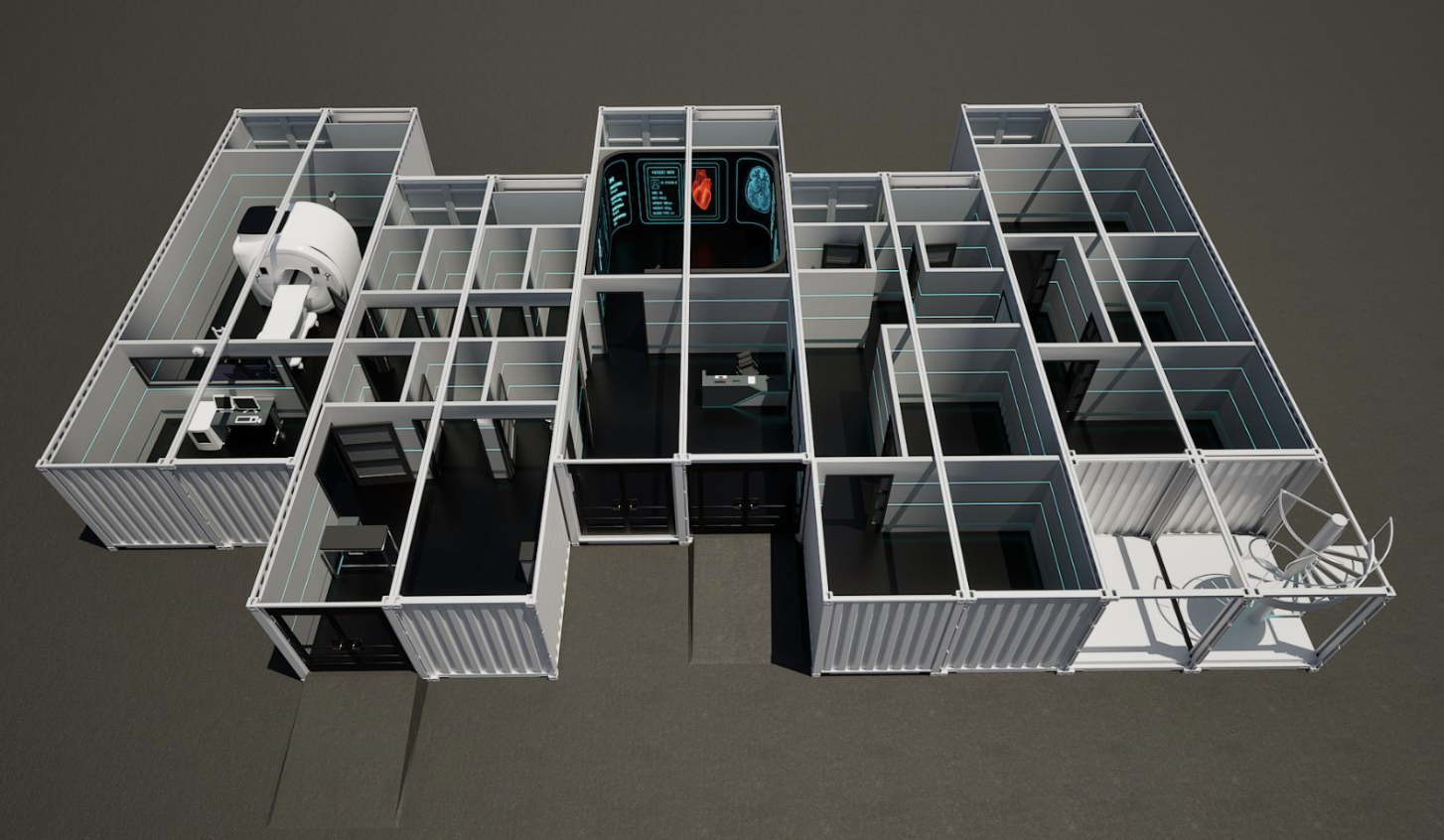
Inside the ScanPod™
This is where advanced digital scanning meets everyday care.
Each space within a ScanPod houses a specialized digital imaging system — from robotic X-ray to MRI, PET, CTs, and ultrasound — arranged for speed, safety, and comfort.
Children and adults can complete every scan in a single visit, with data streamed directly to physicians and researchers studying pediatric disease and Long COVID.
It’s a quiet, efficient environment built for precision and healing.
The ScanPod illustrated above, includes the corner of an O|Zone™ Campus security wall, comprised of 8 - 8' x 40' x 9.5' ISO Intermodal Containers.
Each ScanPod is designed to be located within designated locations within the PAOZ's digital container port.
Each ScanPod is generally expected to comprise approximately 25 40' Intermodal Containers (including the 8 unit Campus security wall integration), plus associated GreenPad units, which facilitate connection between containers and surface attachment, as well as utilities.
Each ScanPod™ is designed to integrate an advanced digital imaging modality.
The unique nature of the O|Zone Initiative includes the use of internationally certified ISO intermodal containers designed to generally include advanced AI digital intellegence, thermal capture designed to produce electricity as self-sustaining micro AI nodes and other forms of specialty functionality. This equipment is specifically designed to qualify for federal 100% bonus depreciation, IRS Section 48E investment tax credits and AGI offsets, as well as state and local tax incentives for equipment purchasers who apply these self-directed incentive capital (SDIC) incentives into O|Zone related projects.
Let's take a Drone flight through the ScanPod™
The short video below illustrates a fly-through of a fully assembled ScanPod™ — a complete scanning and data environment built inside modular GreenBox™ units.
You’ll move from the scanning module itself to the comfort and support spaces designed around it — locker rooms and restrooms where patients can change into scanning attire, a small refreshment area, and a welcoming reception and conference zone with high-tech video walls.
Further inside, you’ll see the secure data center where scan information is processed and stored, along with specialty rooms for video consultations with physicians anywhere in the world.
These spaces can also host immersive, large-scale displays for reviewing scans in detail.
Every module serves a purpose — patient care, data integrity, or collaboration — all connected in one efficient structure dedicated to early detection and advanced diagnostics.
O|Zone - ScanPort™ campus is designed to integrate seven digital scanning modalities, each in its own ScanPod™, positioned within a Campus perimeter, for generating an AI-enabled DigitalTwin™ of each participant.
Together, the seven ScanPods comprise a ScanPort™.
In addition to each of the seven ScanPods, additional Pods may be incorporated into the Campus perimeter and the interior of the site, as illustrated representing singular Pods, as well as purpose specific Ports.
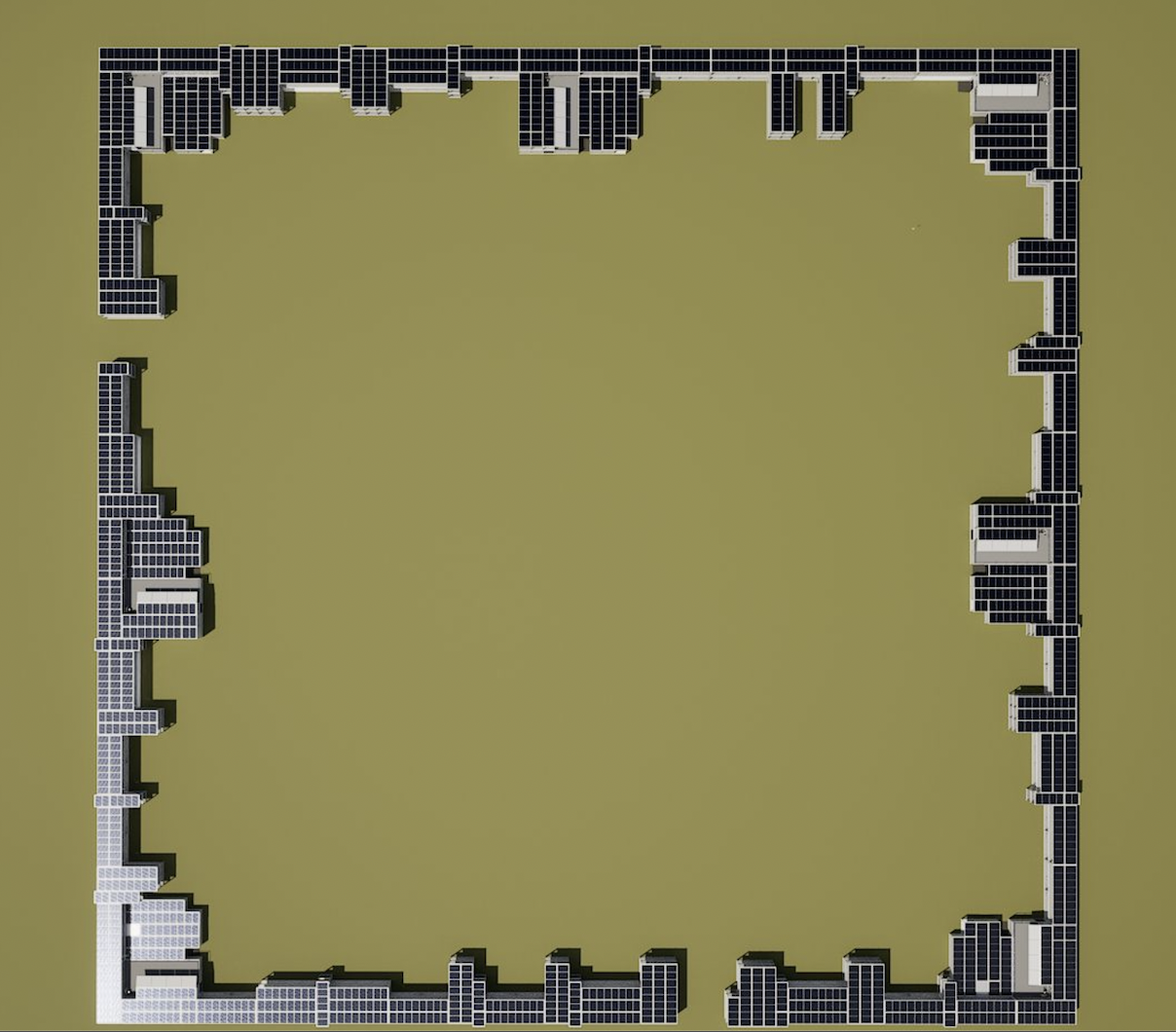
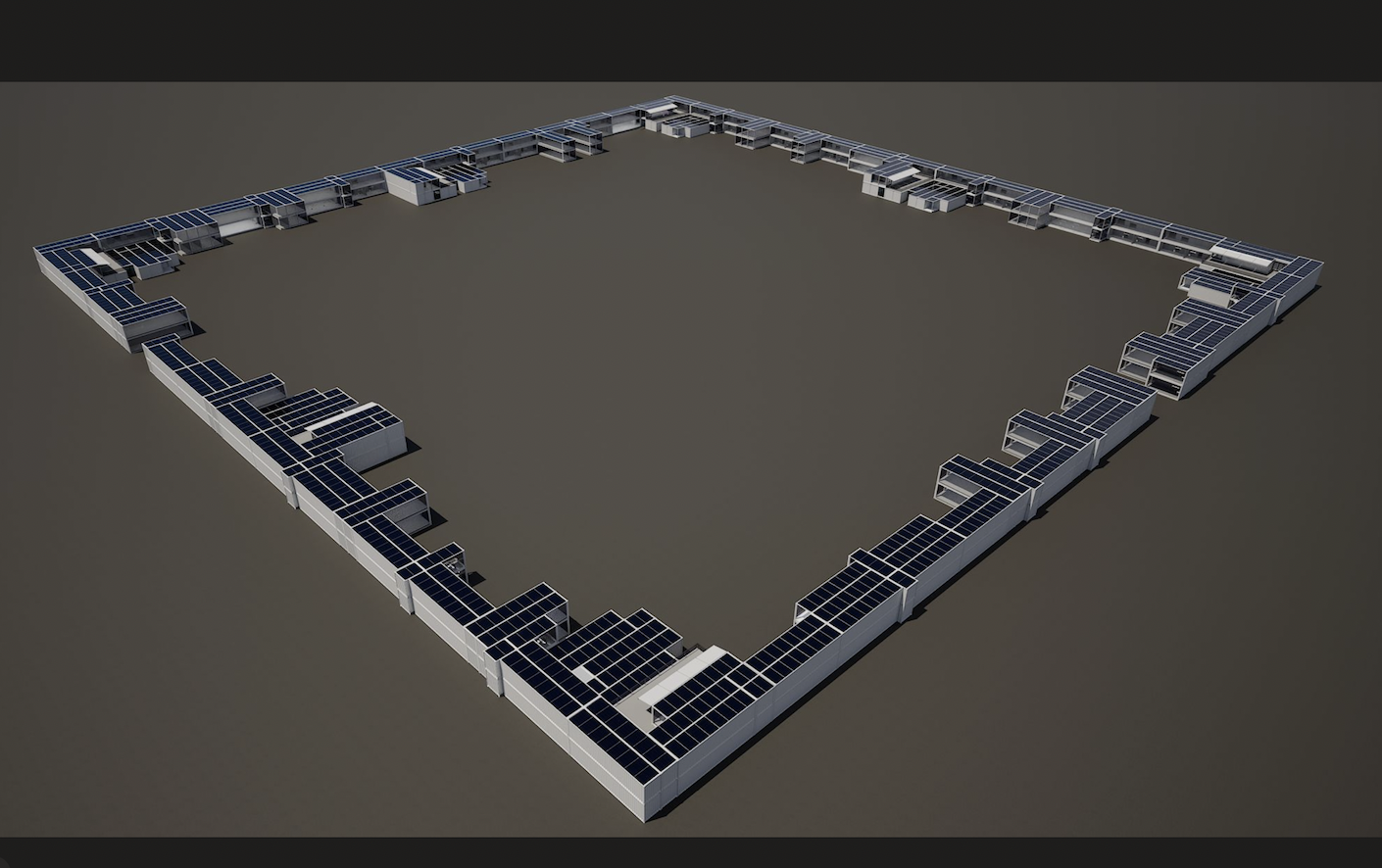
The image above illustrates a Campus configuration, within a designated Digital Container Port. The ScanPort™ image titled Innovative Solutions represents the ScanPod™ located at the top of the diamond shape above. The diamond configuration includes seven ScanPods, one for each digital modality. It also illustrates spaces for a wide range of activities housed in various GreenBox™ Intermodal Container Pod configurations.
The O|Zone campus is designed to take shape as an advanced form of container port, creating a multi-use facility the core building blocks of which are ISO certified containers designed to generate their own electricity and as self-powered ai "edge" nodes designed to advance international trade.
These unique Pod modules may be configured into a variety of facility shapes and sizes, supporting rapid deployment for civic, specialty, industrial and emergency applications.
The ScanPort™ as anchor tenant of the O|Zone™ Campus is designed to utilize GreenBox™ components to house each unique digital scanner in a collection of GreenBox™ Pods, each a micro power station and advanced micro ai compute platform.
The O|Zone™ Campus — Secure, Scalable, and Self-Sustaining
Seen from above, the Campus image illustrates a 10+/- acre self-contained community. Seven ScanPods anchor the corners and sides, forming a secure perimeter with solar roofs, kinetic shielding, and integrated data flow. Inside lies a flexible commons — designed for parks, fountains, small shops, and gathering areas. This is infrastructure built for people, not institutions.
The following images illustrate various GreenBox system components applied within the Campus, with ScanPods comprising each corner and anchoring three exterior walls.
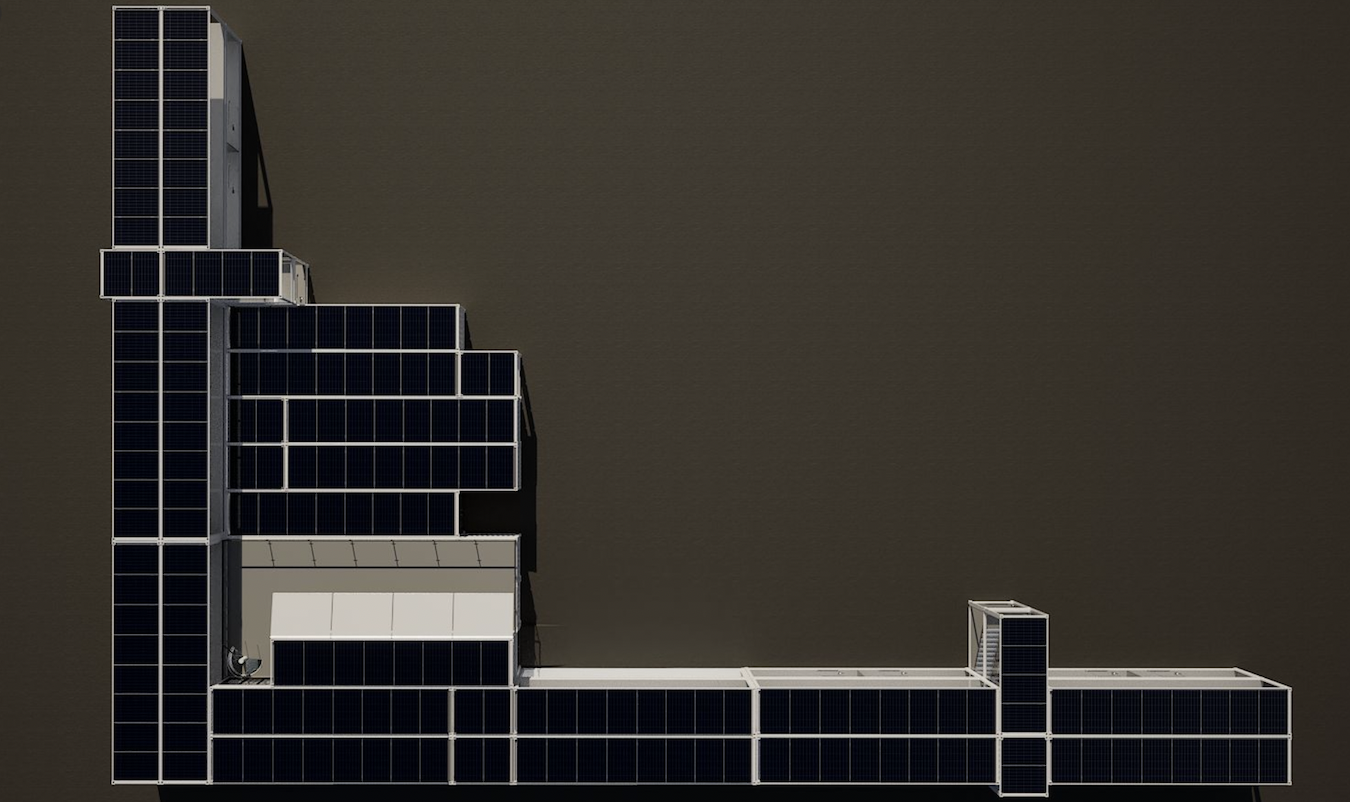
ScanPod
This view shows one of the ScanPort™ corner assemblies — a cluster of GreenBox™ modules configured around a single ScanPod™. Each corner functions as a self-contained scanning and operations unit, capable of running independently or as part of the full complex. You can start to see how extending the form with offices, storage, shops and service corridors hints at something larger — the outline of a connected system beginning to emerge.
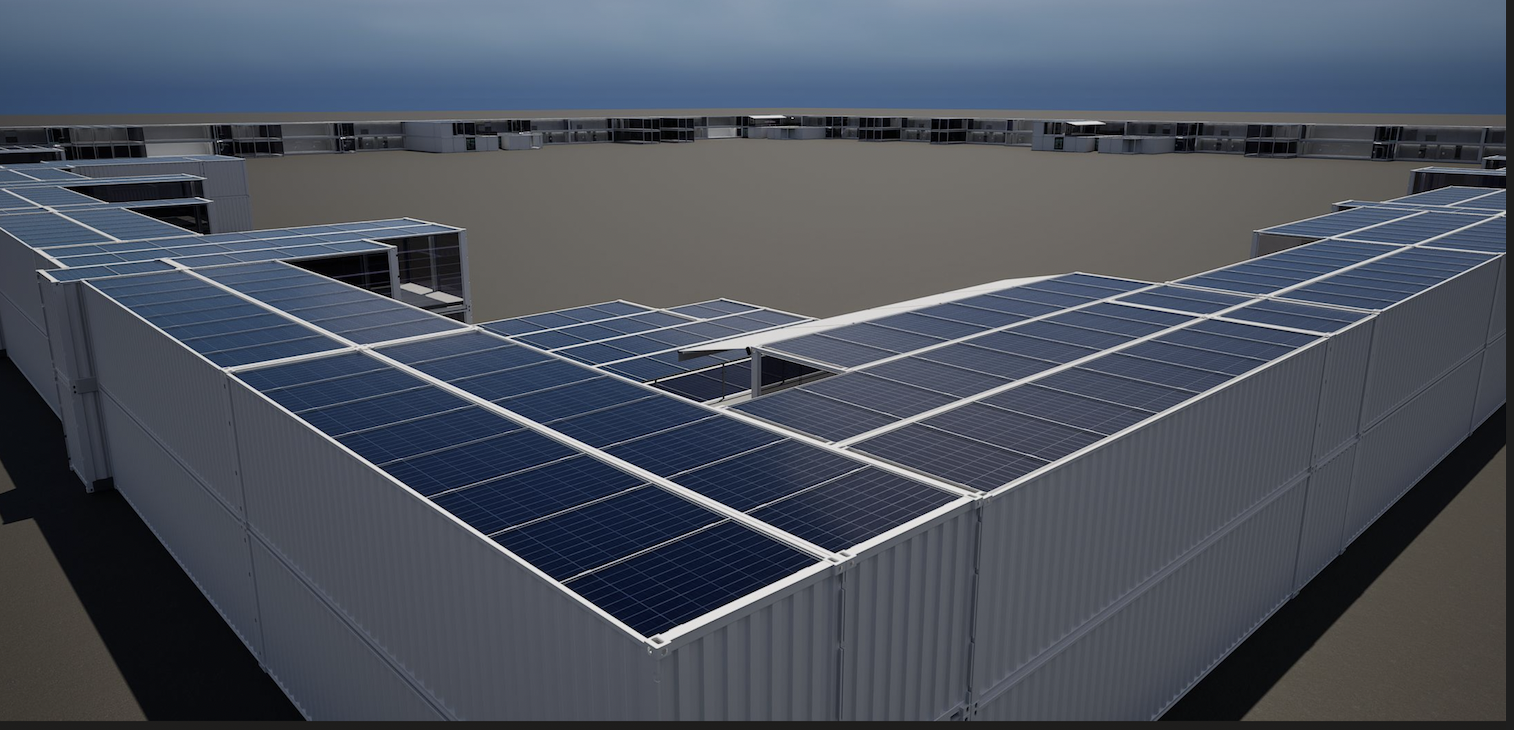
From above, the design reveals its purpose. The interior elevation shows how light, air, and power move across the top of the ScanPort™ structure. Rows of solar-integrated GreenBox™ roofs supply renewable energy to every module below, while interior walls and corridors define secure pathways for patients, staff, and data. It’s a glimpse inside a living framework — built for precision on the outside and care on the inside.
(Some modules described in the context of digital imaging applications)
O|Zone™ Campus - is designed around a central underground Thermal Utility Engine™ located beneath the Town Centre, supported by a network of geothermal wells and GreenPads that anchor each Pod and every future modular facility on the site. This Thermal Utility Engine is designed to distribute clean thermal energy, electrical and digital pathways, and water services through underground modular tunnels (JouleBox™) that connect to all pod-based structures across the 10+/- acre campus.
These foundational elements are to enable the entire site — from the seven ScanPods to research modules, community spaces, office and lodging pods, and educational facilities — to operate on a unified clean-energy and geothermal system designed for long-term stability and expansion.
The image below illustrates the stairway and elevator module designed to provide access to upper stories as well as to TUE tunnels and underground storm shelters and emergency storage facilities.
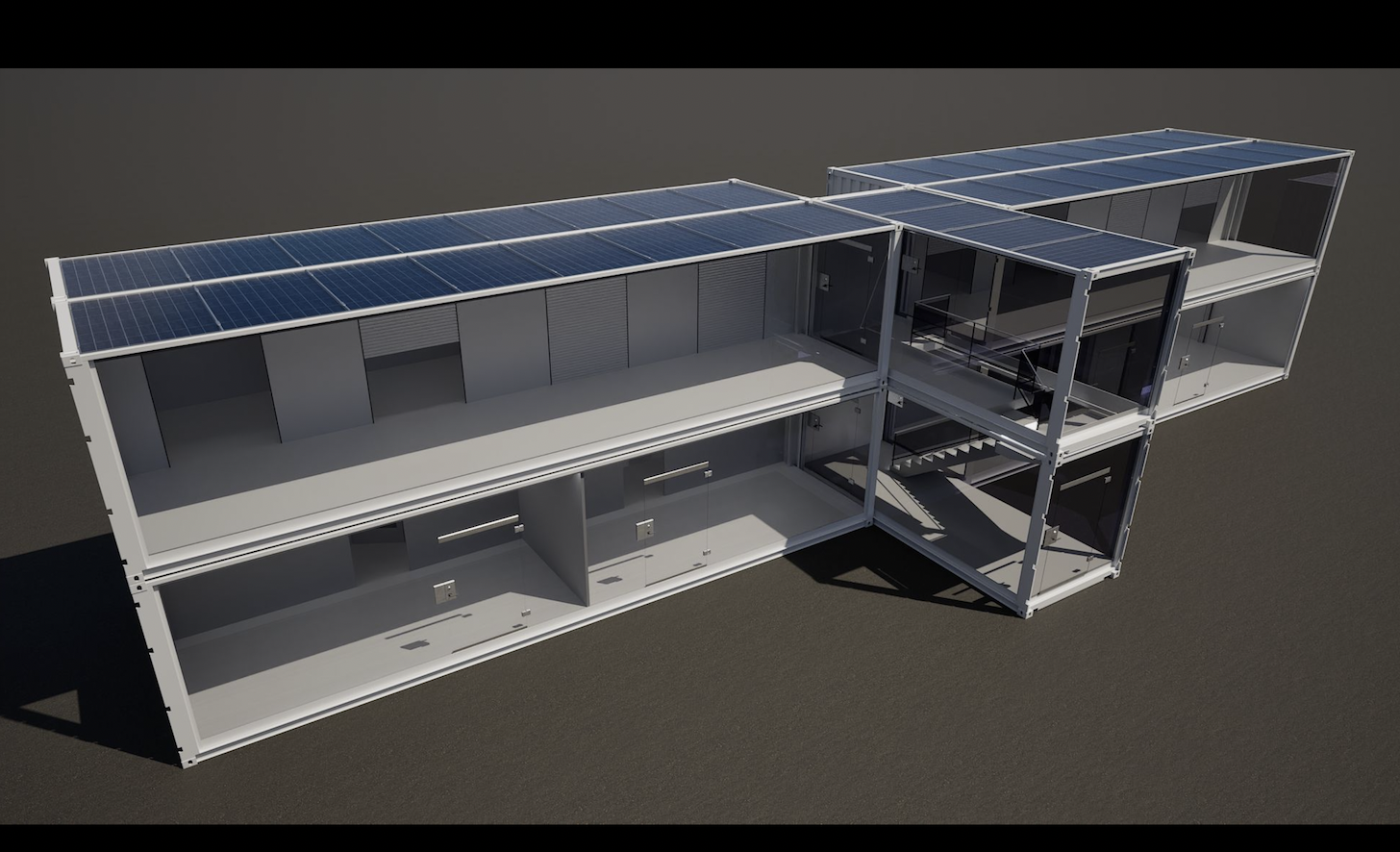
Each GreenBox container is to be connected through its GreenPad to a geothermal well per Pod. Each geothermal well is designed to provide stable, renewable thermal support, while ISO-framed GreenPads distribute this energy across each GreenBox™ container footprint of a Pod™ and connect directly into underground container-based tunnel system that originates at Thermal Utility Engine. The JouleBox™ tunnel system is integrated into a vertical geothermal system through the wells and horizontal geothermal system co-located with the JouleBox™ tunnels.
This configuration gives every Pod™ — and every future pod-based facility in the Campus — a consistent, repeatable foundation with long-term clean-energy support, temperature stabilization, and operational reliability.
Modern campuses rely on electricity as their primary energy currency.
The Thermal Utility Engine™ (TUE) takes a different approach.
TUE is designed around the idea that thermal energy—heat and cold—is the most abundant, flexible, and underutilized resource on a campus. Instead of treating heat as waste and cold as an afterthought, TUE is designed to manage thermal energy as a first-class utility, alongside water, communications, and logistics.
The result is a campus that operates more efficiently, more resiliently, and with far greater flexibility than conventional designs.
What the Thermal Utility Engine™ Is
The Thermal Utility Engine™ is the central thermal infrastructure of the campus.
It functions as:
a BTU reservoir for storing heat and cold,
a thermal router that distributes energy where it is needed,
a temperature conditioner that sharpens hot-side and cold-side performance,
and a coordination layer that allows hundreds of independent systems to operate as a unified whole.
TUE does not replace distributed systems.
It enables them to perform better.
A Campus Utility, Not a Power Plant
TUE is not designed to generate electricity itself.
Instead, each GreenBox™ Beyond Mil-Spec™ on the campus is an independent, self-contained unit capable of producing electricity using closed-cycle systems such as Stirling engines and supercritical CO₂ systems.
TUE’s role is to manage the thermal environment that makes those systems more efficient.
By improving temperature stability and increasing the usable difference between hot and cold, TUE allows each GreenBox™ to:
generate more electricity from the same inputs,
operate more consistently,
and remain resilient under changing environmental conditions.
In simple terms: TUE helps every unit do more with less.
How Thermal Energy Is Captured
Thermal energy enters the system from multiple sources across the campus.
Distributed Capture in GreenBox™ Units
Every GreenBox™ naturally captures and produces heat and cold during operation. Instead of wasting this energy, TUE collects and redistributes it across the site.
Solar Thermal at the Campus Perimeter
Along the campus perimeter, linear parabolic solar troughs are mounted above the containerized wall structure. These troughs rotate to follow the sun and concentrate solar energy into a circulating heat-transfer fluid.
Rather than producing intermittent electricity, this solar energy is delivered as usable heat into the TUE system, where it can be stored and dispatched as needed.
Environmental Exchange
The campus also uses:
natural air movement along the perimeter for cooling,
ambient heat exchange,
and subsurface thermal interaction with the ground.
Together, these sources create a diverse and resilient thermal input portfolio.
Thermal Storage and Conditioning
At the center of the campus, TUE incorporates thermal storage systems operating across multiple temperature ranges.
High-Temperature Storage
High-temperature thermal storage—such as molten-salt systems—enables heat captured during peak conditions to be stored and used later. This stabilizes operations and supports higher-efficiency energy conversion when needed.
Phase-Change Storage (PCM)
Within the underground infrastructure as well as GreenBox™ containers, phase-change materials (PCMs) are used to absorb and release heat at precise temperatures. These modules smooth thermal fluctuations and allow controlled step-up or step-down of temperature as energy moves across the campus.
Cold Storage and Heat Rejection
Cold-side stability is just as important. TUE integrates:
vertical geothermal wells for long-term thermal moderation,
horizontal geothermal loops adjacent to underground JouleBox tunnels for fast response,
and ambient and perturbation-assisted cooling using wind, pressure changes, and natural thermal gradients to enhance cooling and heat rejection—reducing mechanical load while improving system efficiency.
Perturbation-Assisted Cooling
Perturbation-assisted cooling refers to the intentional use of naturally occurring disturbances—such as wind shear, pressure changes, turbulence, and thermal gradients—to enhance heat rejection and cooling efficiency across the campus.
Rather than relying solely on powered fans, wind mills or active mechanical systems, the campus is designed to capture and guide environmental perturbations and convert them into useful cooling work.
At the perimeter of the campus, wind interacting with the outer wall creates predictable upward and accelerated airflow. This airflow is shaped and channeled through perimeter-integrated infrastructure to assist with heat rejection, condenser cooling, and cold-side thermal support. Even modest variations in wind speed and direction can significantly increase effective airflow when properly guided.
Below ground, thermal perturbations caused by temperature differences between tunnels, soil, and geothermal loops are similarly leveraged to improve heat exchange. Horizontal geothermal runs adjacent to JouleBox™ tunnels and vertical geothermal wells provide additional thermal sinks that respond dynamically to load fluctuations.
By working with environmental variability instead of fighting it, perturbation-assisted cooling:
reduces parasitic electrical load,
improves cold-side stability for closed-cycle systems,
enhances overall temperature differentials, and
increases system resilience during peak heat or high-wind conditions.
In the Thermal Utility Engine™, perturbation is not treated as noise—it is treated as useful signal.
This layered approach ensures the campus always has a reliable place to put excess heat.
The JouleBox™ Tunnel Network
Beneath the campus surface, JouleBox™ tunnel containers form the active utility backbone of TUE.
These tunnels:
carry piping, wiring, and control systems,
house thermal modulation and PCM assemblies,
condition energy as it moves between sources, storage, and uses,
and provide protected, serviceable infrastructure that can evolve over time.
Rather than passive conduits, JouleBoxes™ are working infrastructure modules—actively shaping how energy flows across the campus.
Why Temperature Difference Matters
Closed-cycle electrical systems do not depend on fuel.
They depend on temperature difference.
The greater the difference between hot and cold, the more efficiently energy can be converted into electricity.
TUE is designed specifically to:
raise usable hot-side temperatures using solar thermal, molten salt storage and PCM conditioning,
stabilize cold-side temperatures using geothermal and environmental exchange,
and maintain that difference over time.
This coordinated approach allows the campus to generate electricity more efficiently and more reliably, without increasing fuel use or environmental impact.
Scalable from Pod to Campus
TUE is modular by design.
At small scale, it coordinates thermal flows across a ScanPod™ of roughly 25 containerized units.
At full campus scale, it is designed to coordinate 500 or more distributed micro-powerplants and micro-AI centers.
As the campus grows, TUE grows with it—without requiring redesign of the core system.
System Awareness
Effective energy management begins with measurement.
TUE is designed to monitor thermal conditions, electricity flows, cooling capacity, computing loads, and other operational variables throughout the ecosystem.
This continuous awareness enables the system to optimize performance, coordinate resources, and support efficient operation from a single Pod to a full campus deployment.
Beyond Net Zero
By capturing, storing, and reusing thermal energy that would otherwise be wasted, the campus is designed to operate Beyond Net Zero.
In full operation:
on-site systems are designed to meet internal demand,
surplus clean energy can be exported to surrounding communities,
and a portion of net proceeds supports ScanKids™ initiatives.
The Thermal Utility Engine™ makes this possible not by centralizing power, but by orchestrating energy intelligently across the campus.
A New Kind of Utility Function
The Thermal Utility Engine™ represents a shift in how campuses are designed.
It treats thermal energy as a shared resource, not a by-product.
It favors infrastructure over speculation.
And it enables long-term resilience through modular, upgradeable design.
TUE is the utility system that makes the campus work.
O|Zone Campus - begins with a foundation.
A real one — pipes, wells, vaults, thermal systems, pads — but also a foundation of sequencing.
If the order is wrong, loss of time, increased costs, frustration. If the order is right, the entire Campus becomes a self-powered community engine.
We begin with Phase One, which is the period where the site is created in its most essential form. This is where the Thermal Utility Engine™ is built, where the underground architecture takes shape, and where the core Pods are to be located — the anchors of the entire campus — take their places along the early perimeter. Before anything else can happen, the site has to be ready to receive them.
Phase One — Building the Spine of the Campus
Although the public will eventually see the cafés, the gardens, the core facilities, and the extraordinary architecture of the perimeter containers, the real work of Phase One happens long before any of that appears.
It begins with identifying the land, working with the Developer and governmental authorities to establish the framework, running the engineering models, preparing the site, and placing the earliest long-lead equipment orders so fabrication can begin.
The Thermal Utility Engine™ infrastructure is the first major milestone.
It is a significant, coordinated system — geothermal wells; large underground fluid tanks, deep thermal capture corridors; thermal distribution lines; high-pressure vaults; energy balancing pads; sensor-laden conduits; secure trenches; and the underground geometry that enables the movement of heat as intentionally as other sites move air or water. Much of the equipment that runs this system must be fabricated months in advance. That is why the first step of this entire project is the acquisition and fabrication of the Thermal Utility Engine™ equipment.
While this work proceeds with engineers, underground preparation and fabrication teams, the public-sector infrastructure progresses in parallel. The newly formed governmental authorities move forward with tax-exempt municipal bonds to fund roads, shared utilities, site access, lighting, and the other elements of the public backbone. These elements are critical, but they cannot drive the schedule — not the way the Thermal Utility Engine™ does. The TUE is the pace car for the entire development.
As the TUE infrastructure is installed and the first container connetion Pads are located and set, the anchor Pods begin fabrication. Their delivery and placement cannot occur until Phase One TUE systems are ready to receive and interconnect with these GreenBox™ Beyond Mil-Spec™ containers. Their arrival and activation mark the moment the site begins transitioning from development into operations. They are the first real Pod facilities on the campus perimeter. They give the campus its first revenue-producing capability. These anchor Pods are expected to establish key elements of the perimeter wall. They tie directly into the TUE system that has been prepared to receive them.
Phase Two — Expansion Within a Living Framework
Phase Two begins when the campus has an operational heartbeat. The TUE is active, the anchor Pods are installed, the perimeter wall is partially built, and the early public-sector systems are flowing. From this point forward, the site grows inward at the same time.
The perimeter continues to rise with additional GreenBox™ containers — each of which carries its own micro-generation, thermal capture, storage, and distribution systems that plug directly into the architecture Phase One creates. They strengthen the TUE; they do not sit outside it. Every new container makes the whole campus stronger and its energy generation larger.
Inside the perimeter, new Pods take shape. These include research facilities, educational environments, child- and family-centered community spaces, specialty modules, as well as the village-life elements that make the entire development human: cafés, small restaurants, offices, storage, shops, lodging, quiet spaces, energy gardens, and places to meet, talk, rest, and work.
If Phase One is about creating capability, Phase Two is about creating place.
It is the transition from infrastructure to community.
And because the underpinning of the anchor Pods is modular, adaptive, and energy-positive, Phase Two does not have a hard stop. It continues — as the site fills, as systems expand underground, as new research efforts join, and as future Pods are added. Every new Pod adds electrical generation and thermal modulation capacity. Every new Pod strengthens the thermal utility engine that supports the entire campus.
This is how a DX - Digital Container Port Campus grows: by building on top of a foundation designed from the beginning to expand.
An O|Zone campus may be a large-scale undertaking — a campus built to last generations, a fusion of advanced digital intelligence, thermal-electric innovation, community infrastructure, and container-based modular design. The full vision requires a carefully sequenced funding model, one that matches the architecture of the project itself: layered, resilient, and designed to expand as the campus grows.
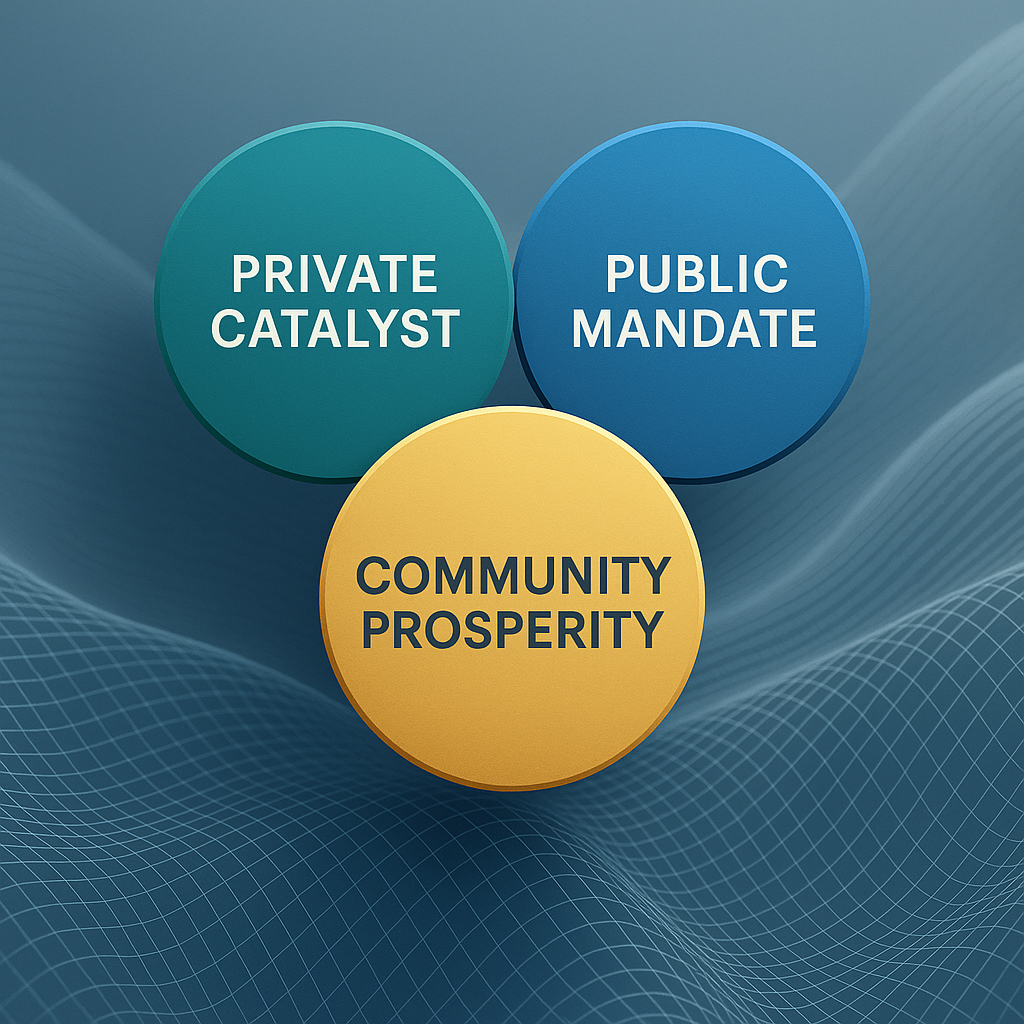
To accomplish this, an O|Zone Campus relies on three coordinated funding pillars, each matched to a different part of the development sequence:
1. Private-Sector Funding for the Thermal Utility Engine™ (TUE) Infrastructure
The first pillar activates immediately. Before the land is fully prepared, before public-sector financing is completed, the TUE — the thermal and electrical backbone of the campus — must begin fabrication. This is long-lead, precision-built equipment, forming the underground and container-level architecture that allows the entire site to function.
To launch this core infrastructure, we begin with privately funded equipment interests. High-income participants have a unique opportunity to allocate federal tax incentives toward the capital formation needed to build the TUE. This early capital is not a supplement — it is the spark that allows Phase One to start. Without it, nothing at the site can be installed, powered, cooled, heated, or stabilized.
2. Public-Sector Infrastructure Funding (Tax-Exempt Municipal Bonds)
As the TUE begins fabrication and installation, the governmental authorities overseeing the site advance the public-sector infrastructure: roads, utilities, access, lighting, and the foundational components required for campus-wide operations. These elements are funded through tax-exempt municipal revenue bonds, supported by Port tariff revenues. They are not funded with taxpayer dollars.
This second pillar does not drive the schedule — it runs in parallel with the private-sector catalyst that begins the project. But it is essential to delivering a fully functioning campus.
3. Private Funding for Pods and Modular Facilities
Once the TUE infrastructure is underway and the site begins taking shape, a separate private-sector program funds the Pods themselves and the specialized modular facilities that form the perimeter and interior structures. These include scanning systems, community pods, research and functional pods, educational environments, and the dozens of specialized units that require custom fabrication.
This pillar runs on its own track, aligned with but distinct from the TUE. It ensures that the anchor tenants — and the supporting architecture can be ready for installation as soon as Phase One infrastructure is prepared to receive them.
⸻
A Funding Architecture Designed for Expansion
These three pillars create a development sequence in which:
• The TUE initiates the project and sets the pace
• Public-sector work follows in stride
• Modular facilities and Pods fill the campus as the backbone comes online
Together, they allow specific Ports to break ground early, accelerate the build cycle, and create a site with a long and expanding operational life.
As the campus moves from development into operations, additional funding cycles and equipment pools may be formed to support expansion, but the initial architecture remains constant:
early private capital creates the infrastructure,
public capital builds the backbone, and
modular capital brings the site to life.
Let us show you our vision: a thermal-based campus where each GreenBox™ - Beyond Mil-Spec™ container acts as a micro power unit and micro-AI center, and where the Thermal Utility Engine™ at the heart of the site brings them together into a single, resilient energy system.
This is not a traditional power plant. It is designed as a distributed network of hundreds of thermal engines working in sync, producing more energy than the campus needs, and putting the surplus to work for the community.
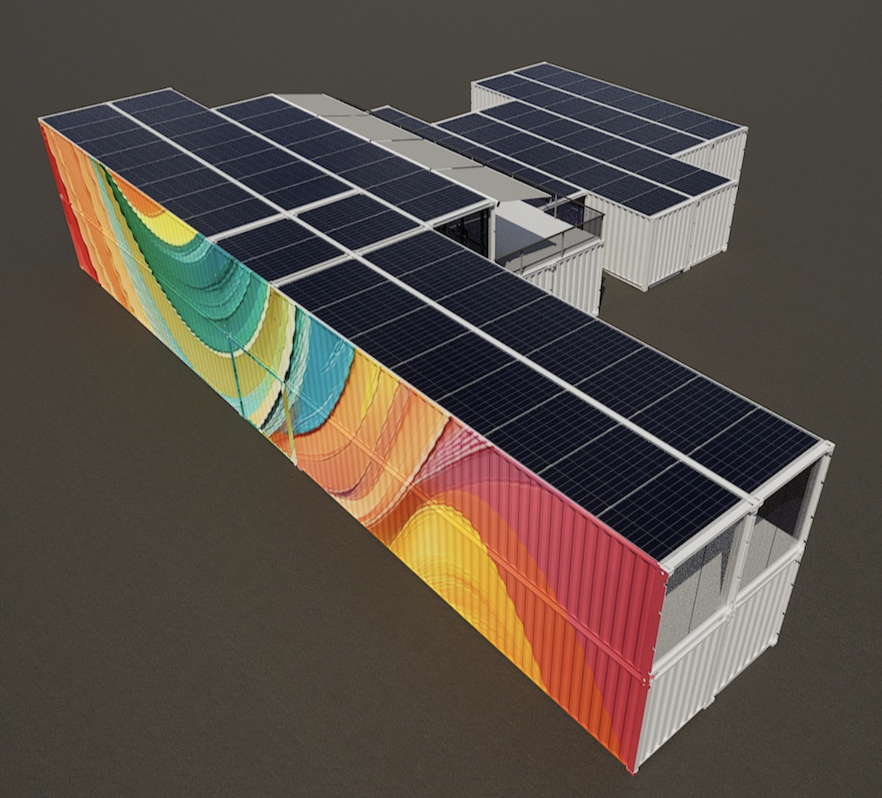
A New Dawn for Community Health
As the sun rises over each ScanPort™, the system quietly powers itself — solar arrays capturing light, cooling systems balancing entropy, and data syncing securely to local medical teams.
It’s not just a building — it’s a living network, designed to restore health, dignity, and hope right where people live.